Stepper Motor Driver Circuit For Arduino
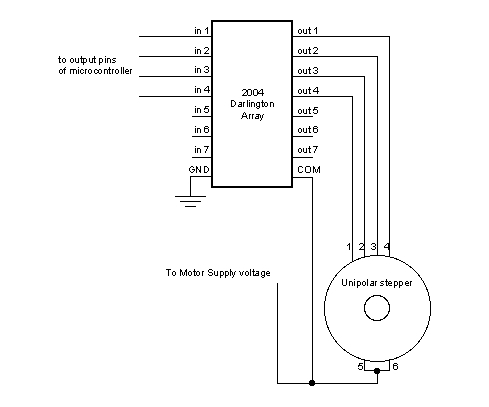
Bipolar stepper motor control with Arduino and an H Bridge It is a well known fact that Stepper motors are awesome The only downside is that they can be a bit trickier to get going than servos and plain old DC motors. If you are interested in the inner mechanics and theory of stepper motors, check this excellent post on PCB heaven. If you happen to have one of the cheap little 2. BYJ 4. 8 steppers with 5 wires and a little driver board with them, check this tutorial instead. Here, I will focus on how to get a bipolar stepper motor typically 4 wires working with Arduino and a H Bridge IC like the L2. D, or the drop in improved replacement SN7. NE. Step 1 Confirm the wiring of your motor. Stepper-Motor-Driver-Circui.gif' alt='Stepper Motor Driver Circuit For Arduino' title='Stepper Motor Driver Circuit For Arduino' />If you have some documentation about your motor than you are set. All we need here is to see how the 4 wires coming out of your bipolar stepper motor are paired in the internal wingdings. If you got your motor from a mystery e. Bay special, or from an old printer, then you need to do some testing with a multimeter. Once you figure out how your stepper is wired, remember the colours of the 4 wires, or mark them. Even if your stepping motor has 6 wires, you can still control it like a four wire stepper motor, you just need to identify the center tap wires. You can do that following the same tutorial on stepper motor wiring mentioned above. Stepper motor performance is strongly dependent on the driver circuit. Torque curves may be extended to greater speeds if the stator poles can be reversed more. Once you figure out the two center taps, you can simply mark them and ignore them, as you will leave them disconnected, focusing on the remaining 4 wires instead. Step 2 Prototype the circuit. Bipolar stepper motors require a bit more complex electronic control circuit than unipolar steppers, like the 2. BYJ 4. 8. You need to be able to reverse the current in the two coils A1. A2 and B1. B2, much like reversing the current across a DC motor to get it to spin forward and backwards. The easiest way to do that is with an H Bridge IC, like the L2. D datasheet, or the SN7. NE datasheet. You will also need a prototype board, some hook up wires, an Arduino Uno, or compatible mocrocontroller, a computer with the Arduino IDE loaded and of course, a stepper motor. Here is a diagram of the circuit I am using in all of the examples below Source Arduino. If you are going to follow along the examples below, you can connect the H Bridge to your Arduino as follows H Bridge Input 1 Arduino Digital Pin 2. H Bridge Input 2 Arduino Digital Pin 4. Introduction Easy to Build CNC Mill Stepper Motor and Driver Circuits. Stepper-tut-01-schema.png?v=1485996064' alt='Stepper Motor Driver Circuit For Arduino' title='Stepper Motor Driver Circuit For Arduino' />Adafruit Industries, Unique fun DIY electronics and kits Adafruit DRV8833 DCStepper Motor Driver Breakout Board ID 3297 Spin two DC motors or step one bipolar. Hi, thanks for the tutorial. Description The Big Easy Driver is a stepper motor driver board for bipolar stepper motors up to 2Aphase. It is based on the Allegro A4983 or A4988 stepper. This page will show you how to wire a stepdir type stepper motor driver board to an Arduino. Happy Wheels Tpb'>Happy Wheels Tpb. The driver board used in this particular example is available from. H Bridge Input 3 Arduino Digital Pin 6. H Bridge Input 4 Arduino Digital Pin 7. Both Enable pins on the H Bridge are connected to 5v always enabled. Note that stepper motors can draw significantly more current than the Arduino 5volt reail can source, so you should get a separate power supply for your motor, and remember to connect all grounds. Navigon 1200 Maps. Step 3 Arduino Code. There are two Arduino libraries that help to manage stepper motors and I will cover both in the examples below, but first I like to test out my set up with some basic Arduino code. This will not be an efficient way to drive the motor, but is a good way to get started and get a feel of what it takes to spin the stepper motor. Example 1 Basic Arduino code no libraryThere are two Arduino libraries that help to manage stepper motors and I will cover both in the examples below, but first I like to test out my set up with some basic Arduino code. Arduino_projekts/StepperLab3_sch.jpg' alt='Stepper Motor Driver Circuit For Arduino' title='Stepper Motor Driver Circuit For Arduino' />This will not be an efficient way to drive the motor, but is a good way to get started and get a feel of what it takes to spin the stepper motor. The code below should make your stepper move counterclockwise 4. It just happens that after some trial and error I figured that my old mystery stepper has 4. A1 2 input 1 of the stepper. A2 4 input 2 of the stepper. B1 6 input 3 of the stepper. B2 7 input 4 of the stepper. Delay 2. 5 Delay between steps in milliseconds. Modein. A1, OUTPUT. Modein. A2, OUTPUT. The ultimate Arduino motor guide Learn all about the most popular motors for Arduino servo, DC, stepper and brushless motors with examples. Description of a simple and cheap stepper motor driver I designed. Modein. B1, OUTPUT. Modein. B2, OUTPUT. Writein. A1, LOW. Writein. A2, HIGH. Writein. B1, HIGH. Writein. B2, LOW. Delay. digital. Writein. A1, LOW. digital. Writein. A2, HIGH. Writein. B1, LOW. Writein. B2, HIGH. Delay. digital. Writein. A1, HIGH. digital. Writein. A2, LOW. Writein. B1, LOW. Writein. B2, HIGH. Delay. digital. Writein. A1, HIGH. digital. Writein. A2, LOW. Writein. B1, HIGH. Writein. B2, LOW. Delay. void stop. Motor. digital. Writein. A1, LOW. Writein. A2, LOW. Writein. Program Cable Box Time Warner here. B1, LOW. Writein. B2, LOW. There are many ways to improve the code above, for example you can make it non blocking by eliminating the delay function, or create a function for cockwise counter clockwise rotation etc. This is what is good about starting with no pre defined libraries you are in full control and can experiment and learn in the process. Example 2 Arduino Stepper library. The Arduino IDE comes with a pre installed Stepper library that does a decent job controlling a stepper motor for basic applications. The example below uses the stepperOne. Step. At. ATime example sketch File Examples Stepper stepperOne. Step. At. ATime to move my stepper one full rotation clockwise, one step at a time, while pausing between steps and printing the step number to the console. Stepper Motor Control one step at a time. This program drives a unipolar or bipolar stepper motor. The motor is attached to digital pins 8 1. Arduino. The motor will step one step at a time, very slowly. You can use this to. If wired correctly, all steps should be in the same direction. Use this also to count the number of steps per revolution of your motor. Then plug that number into the one. Revolution. example to see if you got it right. Created 3. 0 Nov. Stepper. h. const int steps. Per. Revolution 4. Stepper my. Steppersteps. Per. Revolution, 2,4,6,7. Count 0 number of steps the motor has taken. Serial. begin9. 60. Count lt steps. Per. Revolution. Stepper. Serial. printsteps. Serial. printlnstep. Count. step. Count. Example 3 Accel. Stepper library. Once you have covered the basics and are ready to try and push your stepper motor to the limit, you can look into the Accel. Stepper library. This library provides additional features and optimized, non blocking code for controlling multiple steppers at the same time. This library does not come pre installed with the Arduino IDE, so you need to download the zip file and install it Sketch Import Library and select the zip file downloaded from the link above. The example below uses the library to gradually accelerate my stepper motor over 1. Accel. Stepper. h. HALF4. WIRE 8. Motor pin definitions. Pin. 1 2 A1. Pin. A2. Pin. 3 6 B1. Pin. B2. Initialize with pin sequence IN1 IN3 IN2 IN4 for using the Accel. Stepper with 2. 8BYJ 4. Accel. Stepper stepper Defaults to Accel. Stepper FULL4. WIRE 4 pins on 2, 3, 4, 5. Accel. Stepper stepper. HALF4. WIRE, motor. Pin. 1, motor. Pin. Pin. 3, motor. Pin. Max. Speed1. 20. Acceleration1. Speed1. 00. stepper. To1. 20. 00 2. Change direction when the stepper reaches the target position. To. Go 0. To stepper. Position. delay5. And here are all the examples in action well with some of the theory in the start.